Pinal County Court serves as the primary judicial authority for Pinal County, Arizona, operating within the Arizona court system. It holds legal jurisdiction over civil, criminal, traffic, probate, and family-related cases filed at the county level. The court functions under the supervision of the Arizona Supreme Court and follows statewide judicial rules. Judges exercise defined judicial authority to hear cases, issue rulings, and enforce court orders. This system supports lawful dispute resolution across local communities.
Pinal County Court plays a direct role in maintaining legal order and procedural fairness within county boundaries. It processes court dockets, manages hearings, and records official case activity. Court operations support due process, judicial accountability, and public trust in legal outcomes. Its position within the Arizona court system links county proceedings with higher appellate review. This structure shapes how legal rights and responsibilities are applied throughout Pinal County.
How Courts Are Organized Across Pinal County, Arizona
The Pinal County judicial system organizes courts by case type and authority across Pinal County, Arizona. It connects local trial courts with countywide functions to resolve civil, criminal, family, and traffic matters.
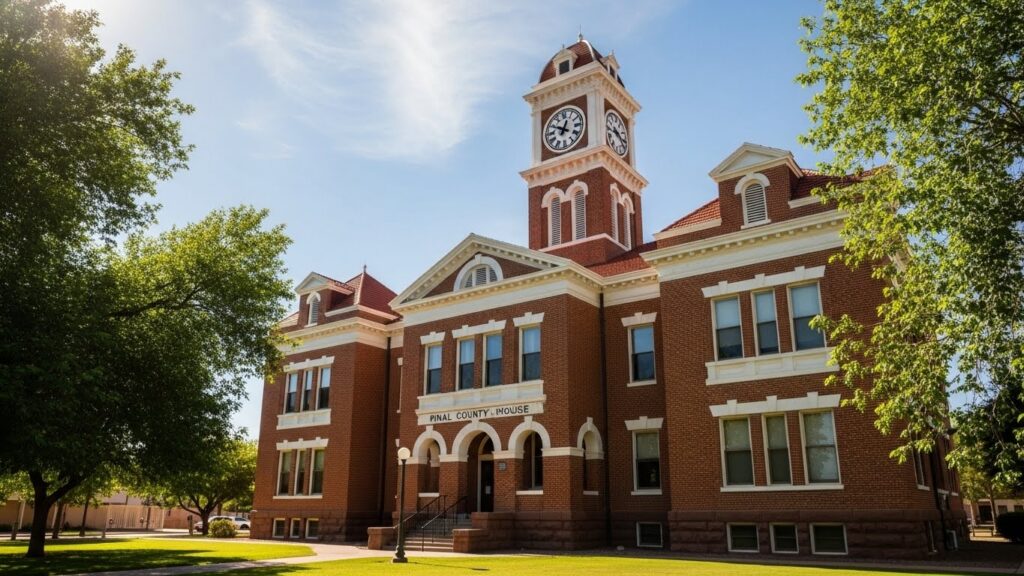
How the Pinal County, Arizona Courts Are Structured
The Pinal County, Arizona, courts operate within a clear judicial framework set by state law. At the county level, courts focus on trial work, case processing, and public services. At the same time, each court handles a defined range of matters based on jurisdiction.
Court structure in Pinal County includes:
- Superior Court is the main trial court
- Justice Courts with limited jurisdiction
- Municipal Courts serving cities and towns
The Pinal County Superior Court manages serious criminal cases, civil disputes with higher dollar amounts, probate, family law, and juvenile cases. Judges hear trials, rule on motions, and issue final orders. This court often works with court administration, probation, and clerk services to move cases forward efficiently.
Justice Courts focus on limited jurisdiction matters. These courts hear misdemeanors, traffic violations, small claims, evictions, and civil cases under a set monetary limit. Municipal Courts handle city ordinance violations, DUI cases, and local traffic offenses. Each court plays a defined role, which helps keep the system organized and predictable.
How Trial Courts Work Together
Pinal County trial courts share responsibilities across locations countywide. This structure supports fair case distribution and timely hearings. At each level, judges follow Arizona statutes and procedural rules.
Key parts of the judicial framework include:
- Subject-matter limits that define what each court may hear
- Geographic boundaries tied to precincts or cities
- Appeal paths that move cases from limited jurisdiction courts to the Superior Court
For example, a traffic case may begin in a Justice Court. If appealed, the matter moves to the Superior Court for review. This layered design supports consistency across Pinal County courts.
Below is a simplified view of how courts differ:
| Court Type | Primary Focus | Jurisdiction Level |
|---|---|---|
| Superior Court | Felony, family, probate | General |
| Justice Court | Traffic, small claims | Limited |
| Municipal Court | City violations | Limited |
Search Pinal County Court Cases and Records
Users can perform a Pinal County Court case search online or in person by using case numbers, party names, or filing dates. Public court records, including civil, criminal, family, and probate cases, are available through the Superior, Justice, and Municipal Courts.
How to Search Pinal County Court Records
To find the right case information quickly, follow these steps:
- Identify the correct court: Superior Court handles civil, criminal, and probate cases, while Justice and Municipal Courts manage traffic violations, small claims, and minor offenses.
- Choose the search method: You can search by case number, party name, or filing date.
- Enter search criteria carefully: Check spelling and include middle initials when possible.
- Select the court location: Narrowing results by court ensures accurate records.
Arizona Court Case Search
Search Page URL:
https://apps.azcourts.gov/publicaccess/caselookup.aspx
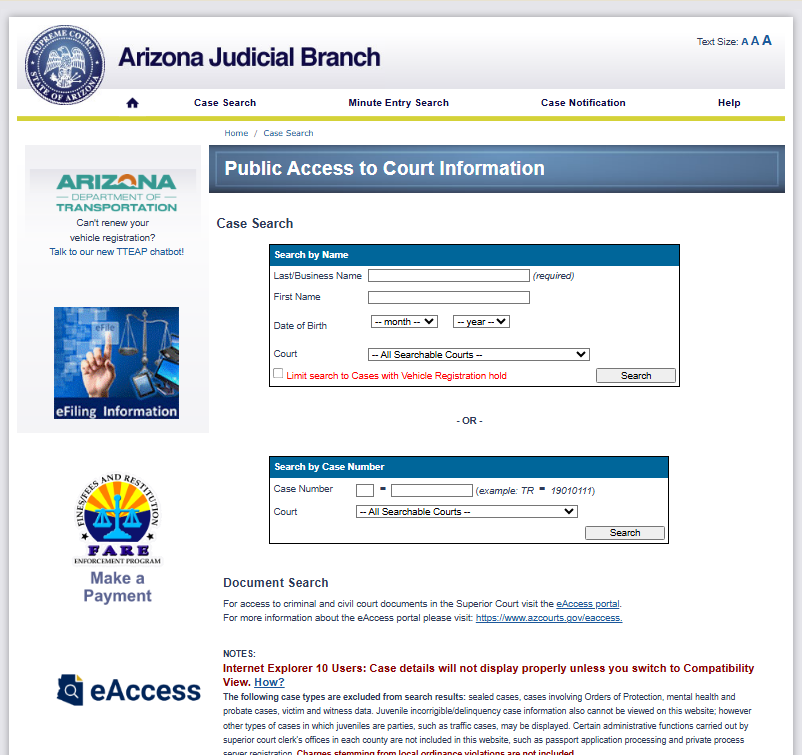
Search by Name
- Open the Arizona Judicial Branch case search page using the link above.
- Go to the Search by Name section.
- Enter the Last or Business Name (required).
- Enter the First Name (optional).
- Select the Date of Birth if available.
- Choose a Court from the dropdown list or keep All Searchable Courts selected.
- Click the Search button to view available case records.
Search by Case Number
- Open the case lookup page:
- Scroll down to the Search by Case Number section.
- Enter the Case Number (example: TR-19010111).
- Select the Court or leave All Searchable Courts selected.
- Click the Search button to access case details.
Arizona Courts eAccess
eAccess Portal URL:
https://www.azcourts.gov/eaccess/
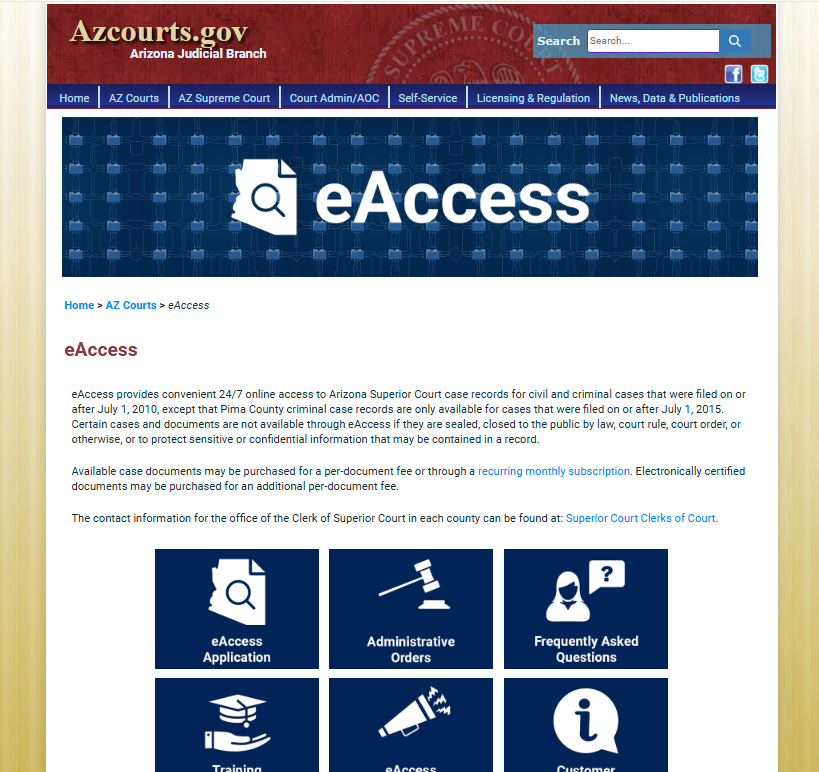
What is eAccess?
- eAccess is the official Arizona Judicial Branch system for accessing court records online.
- It allows users to view case information and court documents.
- This portal provides more detailed records than basic case lookup tools.
How to Use eAccess
- Open the eAccess portal using the link above.
- Select a search option such as Case Number or Party Name.
- Enter the required details in the search fields.
- Review the available case information.
- Some documents may require a user login or a fee to view or download.
Legal Authority and Jurisdiction of Pinal County Courts
Pinal County Courts receive legal authority from Arizona law and the state constitution to hear, decide, and enforce cases within defined limits. Each court operates inside clear geographic boundaries and case-type categories set by statute and constitutional authority.
Source of Court Authority in Pinal County
Pinal County Courts operate under constitutional authority granted by the Arizona Constitution and statutory authority created by the Arizona Legislature. These legal sources define how courts function, what cases they may hear, and how judges exercise judicial power.
Arizona law assigns authority through a structured judicial framework that includes Superior Courts and courts of limited jurisdiction. Judges apply state statutes, court rules, and binding appellate decisions. As a result, court actions carry legal force across the country.
This authority covers issuing orders, conducting trials, approving settlements, and enforcing judgments within approved jurisdictional limits.
Key legal foundations include:
- Arizona Constitution, Article VI
- Arizona Revised Statutes (Title 12 and related titles)
- Arizona Supreme Court administrative rules
Geographic Jurisdiction Within Pinal County
Each Pinal County Court holds authority within county boundaries, which include cities, towns, and unincorporated areas. Superior Court jurisdiction extends across the entire county, no matter where a case begins.
Limited jurisdiction courts operate within smaller zones:
- Justice Courts serve specific precincts
- Municipal Courts serve city or town limits
Cases must originate in the correct location. Filing in the wrong court may delay proceedings or trigger dismissal. Geographic jurisdiction helps courts manage caseloads and maintain local judicial order.
Case-Type Jurisdiction and Jurisdictional Limits
Pinal County Courts hear cases based on subject-matter jurisdiction, which means authority depends on the type of legal issue. Each court level handles defined case categories.
Superior Court handles:
- Felony criminal cases
- Civil cases with higher dollar amounts
- Family law matters, including divorce and custody
- Probate and estate matters
- Juvenile cases
Justice and Municipal Courts handle:
- Misdemeanor criminal cases
- Traffic violations
- Civil disputes below statutory dollar limits
- Evictions and protective orders
Jurisdictional limits protect fairness and efficiency. Lower courts resolve simpler disputes quickly, and higher courts manage complex legal matters.
Pinal County Superior Court
The Pinal County Superior Court is the county’s general jurisdiction court. It hears felony cases, major civil disputes, family law matters, and probate cases. The Pinal County Superior Court holds the highest level of trial court authority in the county. Arizona law grants this court broad legal power, allowing it to hear nearly all case types without strict limits on claim value or penalties. This role places the court at the center of serious and complex legal proceedings.
General Jurisdiction and Legal Scope
As a court of general jurisdiction, the Superior Court handles matters that fall outside the authority of lower courts. This includes felony criminal cases, which often involve jury trials and extended hearings. Judges preside over every stage of these cases, from arraignment through sentencing.
Civil cases in the Superior Court often involve higher monetary claims or complex legal questions. These disputes may relate to contracts, property ownership, or personal injury claims. Court procedures focus on structured case management, formal evidence review, and detailed rulings based on Arizona statutes.
Family Law and Probate Functions
Family law represents another core responsibility of the Pinal County Superior Court. Judges handle sensitive matters that affect households and long-term rights. The court follows Arizona family statutes to promote fair outcomes.
Common family law cases include:
- Divorce and legal separation
- Child custody and parenting time
- Child support and spousal maintenance
Probate cases focus on estate-related issues. This includes wills, trusts, and protective proceedings for minors or incapacitated adults. Court supervision helps protect assets and legal rights.
Locations, Judges, and Case Flow
The Superior Court operates from multiple courthouse locations within Pinal County. This setup allows residents across the county to attend hearings without long travel times. Judges are elected officials who serve set terms under Arizona law.
Cases typically move through several stages:
- Case filing and initial review
- Pretrial conferences and motions
- Trial or settlement
- Judgment and post-trial actions
Court clerks manage records, schedules, and filings. This support keeps cases moving at a steady pace.
Justice Courts
Justice Courts serve a different role within the county system. These courts have limited jurisdiction and focus on lower-level criminal offenses and smaller civil disputes. Their authority is set by statute and applies mainly to cases with defined limits. Justice Courts commonly hear misdemeanor charges, traffic violations outside city limits, and civil cases involving modest claim amounts. Landlord-tenant disputes and eviction cases also fall within their authority. Simpler procedures allow many cases to resolve more quickly.
Municipal Courts
Municipal Courts operate at the city level and handle violations of local ordinances. These courts manage cases that arise within city boundaries and involve municipal law enforcement actions. Typical cases include city traffic tickets, local code violations, and misdemeanor offenses under city regulations. Each municipality administers its own court while following statewide judicial standards.
Justice Courts in Pinal County
Pinal County Justice Courts handle local legal matters with limited jurisdiction, serving as the first point of contact for many cases. These courts focus on misdemeanors, traffic cases, and small civil claims across Pinal County. Pinal County Justice Courts operate at the community level and address cases that require fast, local resolution. These courts hear misdemeanor offenses, civil disputes within set dollar limits, and traffic violations. So, residents often interact with Justice Courts more often than higher courts. Each court serves a defined precinct, which helps manage case volume and local needs.
Justice Courts follow Arizona state law and apply consistent court procedures. Judges preside over hearings, issue rulings, and manage trials without juries in many cases. For some matters, parties may request a jury trial. Then, court staff assist with filings, scheduling, and fee payments. This structure supports efficiency and clarity for the public.
Common case types heard in Pinal County Justice Courts include:
- Misdemeanors, such as minor criminal charges
- Civil claims, often involving landlord-tenant disputes
- Small claims, usually below statutory dollar limits
- Traffic and civil traffic violations
- Protective orders, including orders of protection
Limited Jurisdiction and Local Impact
Justice Courts hold limited jurisdiction, which means they hear only certain case types defined by law. For example, felony cases move to higher courts after early hearings. So, Justice Courts focus on swift case handling and local service. Many residents value these courts for quicker timelines and clear procedures.
Types of Courts in Pinal County
Pinal County has a structured court system that includes Superior, Justice, and Municipal Courts, each serving specific legal functions. These courts handle cases ranging from serious criminal matters to minor disputes and local ordinance violations.
Pinal County Superior Court
The Pinal County Superior Court is the highest trial court in the county and has general jurisdiction over civil, criminal, family, and probate matters. It handles complex cases, including felony charges, divorce proceedings, child custody disputes, and estate administration.
This court is divided into several divisions:
- Criminal Division: Oversees felony cases and serious criminal offenses.
- Civil Division: Handles civil disputes, including contracts, personal injury, and property claims.
- Family Division: Manages cases involving divorce, child custody, domestic violence, and support orders.
- Probate Division: Administers wills, estates, guardianships, and conservatorships.
The Superior Court also conducts jury trials, motions hearings, and appeals from lower courts. Its judges are elected and have authority across the county. For residents facing serious legal issues, this court provides the final trial-level venue within Pinal County.
Key Points About Pinal County Superior Court:
| Division | Types of Cases |
|---|---|
| Criminal | Felonies, serious criminal offenses |
| Civil | Contracts, personal injury, property disputes |
| Family | Divorce, custody, support, domestic violence |
| Probate | Wills, estates, guardianships, conservatorships |
Justice Courts in Pinal County
Pinal County Justice Courts operate under limited jurisdiction, focusing primarily on less severe offenses and civil claims of smaller monetary value. These courts are ideal for handling misdemeanors, traffic violations, and civil disputes involving minor financial amounts.
Justice Courts serve as a local point for initial hearings and legal procedures. They provide a faster resolution compared to the Superior Court and help reduce the workload of higher courts. Residents often appear here for small claims, landlord-tenant disputes, and misdemeanor cases.
Common Cases in Justice Courts:
- Traffic infractions and minor violations
- Petty criminal offenses and misdemeanors
- Small claims up to a specified monetary limit
- Local ordinance violations
Justice Courts are spread across the county to provide convenient access for residents. They play a crucial role in efficiently handling minor legal matters while maintaining fairness and legal oversight.
Municipal Courts in Pinal County
The Pinal County Municipal Courts handle cases that occur within city or town limits, mainly focusing on local ordinance violations, traffic offenses, and other municipal matters. They operate as city courts and ensure compliance with local laws.
These courts address minor criminal offenses, parking and traffic tickets, and code enforcement issues. Municipal Courts are often the first point of contact for residents receiving citations or facing local disputes.
Typical Municipal Court Cases:
- Traffic and parking violations
- City ordinance infractions
- Petty theft or minor criminal offenses within city limits
Municipal Courts provide an accessible and efficient way for communities to resolve disputes without moving to higher courts. They help maintain local order while offering residents a clear process for resolving city-level legal issues.
Summary Table: Pinal County Court Types
| Court Type | Jurisdiction | Typical Cases |
|---|---|---|
| Superior Court | General jurisdiction | Felonies, family law, civil disputes, probate |
| Justice Court | Limited jurisdiction | Misdemeanors, small claims, traffic violations |
| Municipal Court | City/city-level jurisdiction | Local ordinance violations, traffic, minor crimes |
Trial Courts and Case Types Handled
Pinal County trial courts handle a wide range of cases, including criminal, civil, and family matters. They serve as the first level where most disputes and legal issues are formally resolved.
Trial courts in Pinal County are responsible for hearing and deciding cases that involve civil litigation, criminal prosecution, and family disputes. Civil cases often include disagreements over contracts, property, or personal injuries, while criminal cases range from misdemeanors to serious felonies. Family-related matters, such as divorce, child custody, and support, are also managed at this level. Each case type follows specific procedures to ensure fairness and adherence to state laws.
Civil Litigation Cases
Civil cases in Pinal County trial courts typically begin when one party files a complaint against another. Key steps in civil proceedings include:
- Filing of a complaint or petition
- Service of legal notice to the opposing party
- Pretrial hearings or mediation sessions
- Trial, if a settlement or resolution is not reached
Judges consider evidence, witness testimony, and legal arguments before issuing a judgment. Civil cases may result in financial compensation, injunctions, or other court orders.
Criminal Prosecution
Criminal cases start when the state charges an individual with violating the law. Pinal County trial courts handle both misdemeanor and felony cases. The criminal process generally involves:
- Initial arraignment and plea entry
- Pretrial motions and hearings
- Trial with presentation of evidence by prosecution and defense
- Sentencing if the defendant is found guilty
The courts ensure defendants receive a fair trial, consistent with Arizona state criminal procedures.
Family Disputes
Family law matters often require sensitive handling. Pinal County trial courts oversee cases like:
- Divorce and property division
- Child custody and visitation
- Child and spousal support
- Domestic violence or protective orders
Courts aim to resolve these disputes while prioritizing the welfare of children and vulnerable parties. Mediation or counseling may be recommended to assist families in reaching agreements.
Court Administration and Clerk of the Court
The Pinal County Court is managed through an organized system of court administration, led by the Clerk of the Court, who oversees essential operations and ensures cases progress efficiently. The office handles official records, court filings, and daily administrative duties that keep the legal process running smoothly.
Role of Court Administration
Court administration in Pinal County manages the overall workflow of the court system.
This includes:
- Scheduling hearings and trials to prevent conflicts and maintain efficiency.
- Maintaining case management systems for tracking active and closed cases.
- Supervising court staff who assist judges, attorneys, and the public.
- Ensuring compliance with legal procedures and reporting requirements.
By handling these responsibilities, court administration ensures that legal matters move through the system without unnecessary delays. It acts as the backbone of judicial operations, coordinating between judges, attorneys, and the public.
Responsibilities of the Clerk of the Court
The Clerk of the Court plays a pivotal role in the Pinal County judicial process.
Their duties include:
- Managing court filings such as petitions, motions, and evidence submissions.
- Maintaining official records, including civil, criminal, and family case documents.
- Providing information to the public regarding case status and court schedules.
- Collecting fees, fines, and court costs accurately and securely.
The Clerk ensures that every document is properly recorded and accessible for legal reference, supporting transparency and accountability.
Key Functions at a Glance
| Function | Description |
|---|---|
| Case Management | Tracking all pending and closed cases efficiently |
| Court Filings | Recording motions, petitions, and legal documents |
| Official Records | Maintaining accurate and secure court documents |
| Public Support | Assisting with inquiries, forms, and fee payments |
Common Case Categories in Pinal County Courts
Pinal County courts handle a wide range of legal matters, including civil disputes, criminal charges, family issues, probate matters, and juvenile cases, each with specific procedures and requirements.
Civil Cases
Civil cases in Pinal County involve disagreements between individuals or organizations over property, contracts, or personal injuries, requiring formal case filings and hearings. Typical matters include landlord-tenant disputes, business contract disagreements, and claims for damages caused by negligence, with judges following a structured judicial process to ensure fairness.
Criminal Cases
Criminal cases cover violations of state law, from misdemeanors to felonies, and involve initial hearings, arraignments, trials, and sentencing. Prosecutors represent the state, defense attorneys protect the accused, and case filings include charges, motions, and pretrial requests, while courts manage penalties such as fines, probation, or incarceration based on the offense.
Family Law Matters
Family law matters address divorce, child custody, child support, and spousal maintenance, often requiring detailed documentation and hearings to determine arrangements and responsibilities. Judges strive to protect children’s best interests and balance parental rights, with mediation and negotiation frequently used in the judicial process to resolve conflicts efficiently.
Probate and Estate Cases
Probate and estate cases involve managing a deceased person’s property and assets, including validating wills, distributing property, and appointing executors or personal representatives. The court ensures that case filings meet legal requirements and that heirs and creditors receive proper consideration, sometimes including guardianships for minors or adults unable to manage their affairs.
Juvenile Cases
Juvenile cases involve offenses committed by individuals under 18, focusing on rehabilitation rather than punishment, and include delinquency matters, status offenses, and child protection cases. Hearings may involve assessments, counseling, or placement in specialized programs, with judges aiming to achieve positive outcomes while holding minors accountable under the judicial process.
Appeals and Judicial Review Process
The appeals process in Pinal County allows parties to challenge a trial court’s decision in a higher court. Judicial review ensures that legal procedures were properly followed and that rulings comply with applicable laws.
When a party believes a trial court has erred, they can file an appeal with the appropriate appellate court. This process focuses on reviewing the application of law rather than re-examining factual evidence. Appellate courts in Arizona examine whether the lower court followed proper procedures, applied statutes correctly, and respected constitutional rights.
Steps in the Appeals Process
- Notice of Appeal: The appellant formally informs the court of their intent to challenge a decision.
- Record Preparation: All trial documents, transcripts, and evidence are compiled for the appellate court’s review.
- Written Briefs: Each side submits detailed arguments. The appellant outlines alleged errors, while the respondent defends the lower court’s ruling.
- Oral Arguments: Judges may hear presentations from attorneys, asking questions to clarify legal points.
- Decision Issued: The appellate court can affirm, reverse, or remand the case for further proceedings.
Key Points About Judicial Review
- Limited Scope: Appeals do not retry witnesses or present new evidence.
- Time-Sensitive: Filing deadlines are strictly enforced.
- Legal Representation: Experienced appellate attorneys can improve the clarity and persuasiveness of arguments.
Pinal County’s appeals process provides a structured system for reviewing trial decisions. Understanding each stage—from filing notices to receiving a judgment—helps parties pursue their legal rights efficiently.
Court Locations and Service Areas
Pinal County Court maintains a network of court locations and service districts that let residents get help nearby. Each courthouse facility has defined services, contact details, and areas it serves within the county.
Below is a clear list of the main courthouses and justice court locations with street addresses, phone numbers, and available email contacts so people can find the right office fast.
Office of the Clerk of the Superior Court
- Address: 971 N. Jason Lopez Cir, Bldg A, Florence, AZ 85132
- Phone: (520) 509‑3555 or toll‑free (888) 431‑1311
- Email: Not publicly listed
- Services: Handles civil, criminal, family, and probate cases; full court services and case management
Pinal County Superior Court
- Address: Same as above
- Phone: (520) 866‑5400
- Email: Not publicly listed
- Services: General Superior Court matters, including civil, criminal, probate, and family cases
Pinal County Precinct II Justice Court
- Address: 820 E. Cottonwood Lane, Casa Grande, AZ 85122
- Phone: (520) 866‑7475
- Email: casagrandejusticecourt@courts.az.gov
- Services: Justice court for the Casa Grande area, including traffic, small claims, and limited civil cases
Apache Junction Justice Court
- Address: 575 N. Idaho Rd., Suite 200, Apache Junction, AZ 85119
- Phone: (480) 982‑2921
- Email: apachejunctionjc@courts.az.gov
- Services: Handles traffic, misdemeanor, and minor civil cases; serves Apache Junction, Gold Canyon, Queen Valley
Pioneer Justice Court
- Address: 3675 E. Hunt Hwy, San Tan Valley, AZ 85143
- Phone: (480) 380‑7312
- Email: pioneerjc@courts.az.gov
- Services: Justice court for San Tan Valley; handles minor civil, traffic, and small claims cases
Western Pinal Justice Court
- Address: 19955 N. Wilson Ave, Maricopa, AZ 85139
- Phone: (520) 866‑3999
- Email: westernpinaljusticecourt@courts.az.gov
- Services: Serves the Maricopa area; handles misdemeanor, traffic, and minor civil disputes
Central Pinal Justice Court
- Address: 119 W. Central Ave, Coolidge, AZ 85128
- Satellite: 801 N. Main St., Eloy, AZ 85131
- Phone: (520) 866‑7900
- Email: centralpinaljc@courts.az.gov
- Services: Covers Florence, Coolidge, and Eloy; handles traffic, misdemeanor, family, and small civil cases
Florence Municipal Court
- Services: Municipal court cases in Florence
- Address: 775 N. Main St., Florence, AZ 85132
- Phone: (520) 868‑7514
Frequently Asked Questions About Pinal County Court
Pinal County Court handles a variety of legal matters, including civil disputes, criminal cases, family issues, and probate matters. The court is structured to manage these cases efficiently while ensuring fair outcomes for everyone involved.
What Types of Cases Does Pinal County Court Handle?
Pinal County Court oversees a wide range of cases, including civil litigation, criminal prosecutions, family law disputes, and probate matters. Civil cases involve disagreements over contracts, property, or personal injury, while criminal cases address offenses from minor violations to serious felonies. Family law cases cover divorce, child custody, and support matters, and probate cases handle wills, estates, and guardianships. Each type of case is assigned according to its nature and the court’s jurisdiction, ensuring that legal matters are resolved in the appropriate venue.
Which Court Has Jurisdiction Over My Case?
Jurisdiction in Pinal County depends on both the type of case and the location where it arises. Justice Courts generally handle minor criminal offenses, traffic matters, and small civil claims, while the Superior Court deals with major civil disputes, serious criminal cases, and family law matters. The geographic location of the parties or incident also determines the proper court, helping to ensure that cases are heard in the correct district and handled efficiently according to Arizona law.
How Are Courts Structured in Pinal County?
Pinal County courts are organized in a tiered system to handle cases effectively. Justice Courts focus on smaller claims, minor criminal offenses, and traffic violations. Superior Court serves as the main trial court and handles major civil and criminal cases, along with specialized divisions for family law, probate, and juvenile matters. This structured approach ensures that cases are assigned to judges and staff with the expertise needed for fair and timely resolutions.
What Is the Role of the Superior Court?
The Superior Court acts as the primary trial court in Pinal County, responsible for managing serious civil and criminal cases as well as family and probate matters. Judges in Superior Court conduct trials, hear motions, oversee jury proceedings, and ensure that legal procedures are followed correctly. The court also handles appeals from Justice Courts, providing a higher level of review when parties contest lower court decisions. Its role is central to maintaining order, fairness, and accountability within the county’s judicial system.
How Does the Appeals Process Work?
If a party disagrees with a court’s decision, they may file an appeal to have the ruling reviewed. In Pinal County, appeals from Justice Courts are usually heard by the Superior Court, while appeals from Superior Court decisions proceed to the Arizona Court of Appeals. The appellate court reviews the case for legal errors rather than reevaluating factual evidence. Through this process, the court ensures that judicial decisions comply with the law and that parties have a fair opportunity to challenge outcomes they believe are incorrect.